
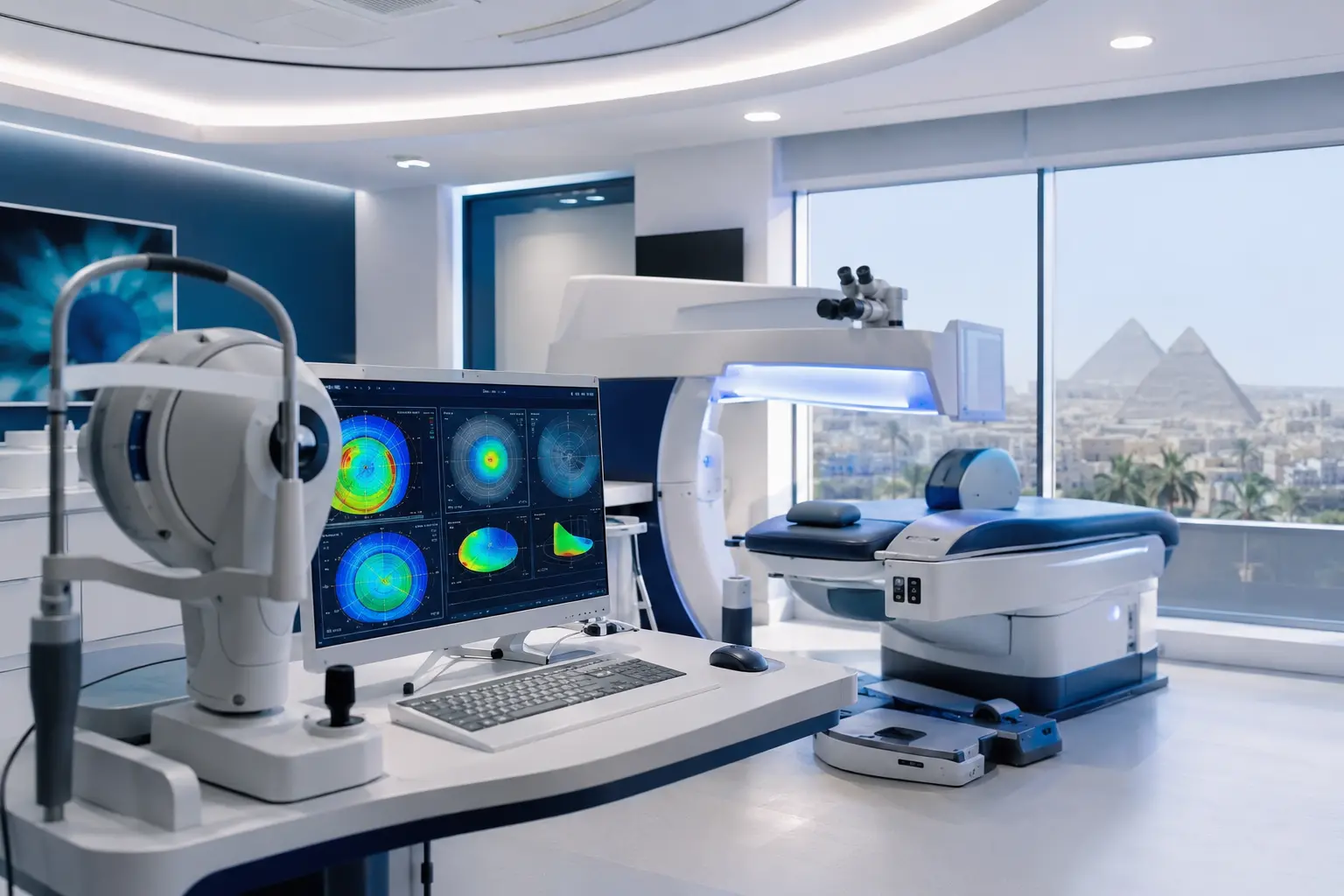
Why the names cause confusion
FemtoLASIK explains how a flap is made. Contoura, topography-guided, wavefront-guided and optimized explain how the excimer correction is designed. A patient can therefore have FemtoLASIK with more than one possible treatment profile.
Clinics sometimes turn these technical terms into a ladder of basic, premium and best. A clinically useful comparison asks what each profile measures and whether that information changes the plan for this eye.
Contoura and topography-guided planning
A topography-guided plan uses detailed measurements of the anterior corneal surface and alignment data. Contoura is Alcon’s brand for this type of workflow on compatible WaveLight technology, so the trademark should not be applied to unrelated platforms.
Topography can reveal asymmetry, decentration and surface irregularity, but a map is also sensitive to tear-film quality and acquisition. Repeating scans after contact-lens discontinuation or dry-eye treatment may change the apparent pattern.
Wavefront-guided Custom LASIK
Wavefront aberrometry measures how light travels through the full optical system of the eye. It can quantify lower-order prescription and higher-order aberrations that ordinary sphere and cylinder do not describe. A wavefront-guided profile aims to incorporate reliable patient-specific optical data.
The source of an aberration matters. If it arises mainly from the crystalline lens rather than the cornea, applying a corneal treatment may not be the correct solution. Repeatability, pupil conditions and the relationship to the manifest refraction need review.
Wavefront-optimized treatment
An optimized profile usually bases correction on the refraction while modifying peripheral treatment to limit unwanted changes in corneal shape and spherical aberration. It does not attempt to neutralize every patient-specific map or wavefront feature.
That is not the same as inferior. For a regular cornea with no reproducible higher-order target, an optimized profile may be proportionate and predictable. More customized data should be used because it adds value, not because the package name is more expensive.
Which measurements decide?
The decision combines refraction, corneal topography or tomography, pachymetry, pupil and centration data, ocular-surface quality and wavefront information when relevant. The surgeon also calculates optical zone, ablation depth and residual tissue.
When datasets disagree, treatment should pause. Managing dryness, stopping contact lenses for an appropriate period and repeating measurements is safer than forcing conflicting numbers into a guided plan.
- Are the maps repeatable?
- Does manifest refraction agree with the measured data?
- Is the cornea regular and biomechanically acceptable?
- Is the intended profile available and approved on the named platform?
The result is a profile choice, not a sales tier
Some patients may have more than one reasonable profile. Others have one clearly preferable route, and some should not have corneal laser treatment. The consultation should connect the recommendation to findings visible in the record.
A responsible clinic also explains ordinary risks, likely recovery and enhancement options. A sophisticated map does not guarantee perfect night vision or eliminate dry eye, residual prescription or future age-related change.
Useful questions for your consultation
Use these prompts to keep the discussion connected to your measurements, risks and visual goals.
- Which profile are you recommending by its exact name?
- What measurement justifies it?
- Do my topography and wavefront agree?
- What would make you change or cancel the plan?
Frequently asked questions
Is Contoura always more expensive?
Pricing varies by clinic and consumables. Cost does not establish medical value; ask why the profile is indicated and what the total package includes.
Can Custom LASIK be performed with FemtoLASIK?
Yes. Femto describes flap creation and custom describes the excimer plan, so they can be combined.
Which is best for night vision?
No label guarantees better night vision. Pupil size, prescription, existing aberrations, tear film, optical zone and healing all matter.
What if my scans do not agree?
The surface and contact-lens effects should be addressed and measurements repeated. Elective treatment should not proceed from unreliable data.
Medical sources and further reading
This article was reviewed against the following patient-information resources. Individual recommendations still depend on examination.