
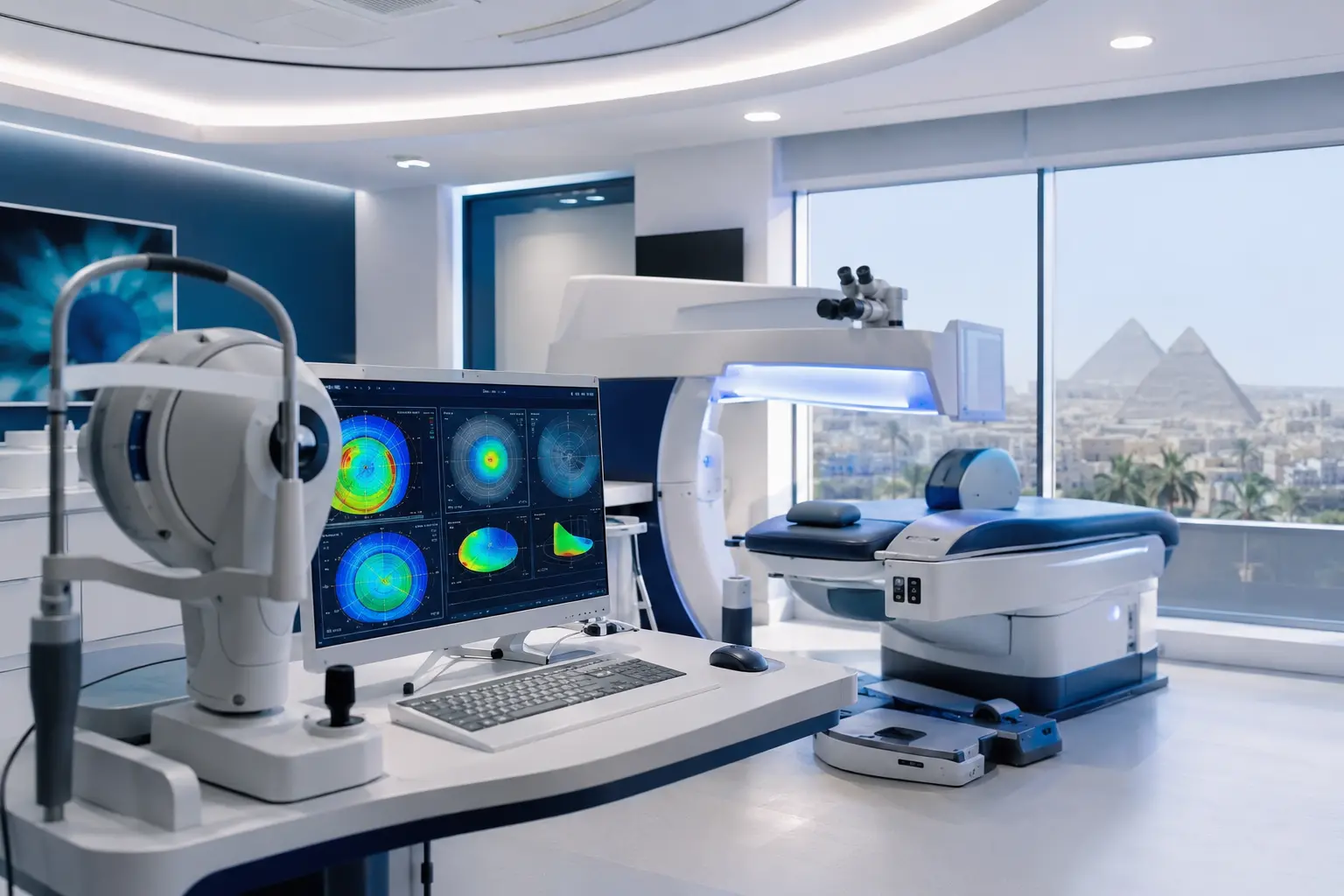
First, separate the access method from the treatment profile
Procedure names often mix two different decisions. The first is how the surgeon reaches the corneal tissue: a mechanical flap, femtosecond-laser flap, surface treatment or small-incision lenticule extraction. The second is how the optical correction is designed: optimized, wavefront-guided or topography-guided.
A patient can therefore have FemtoLASIK with a standard optimized profile or FemtoLASIK with a customized profile. Calling every customized treatment ‘a different LASIK’ can make comparisons confusing.
- Access: flap, surface or small incision
- Optical plan: optimized, wavefront-guided or topography-guided
- Suitability: prescription, tomography, tissue, surface and lifestyle
Conventional LASIK
Conventional LASIK uses a microkeratome to create a corneal flap. An excimer laser then reshapes the underlying stroma and the flap is repositioned. The method has a long clinical history and can produce good results in selected eyes.
Its limitations include flap-related risks and less programmability of flap geometry than femtosecond-laser creation. The word conventional does not mean careless; the result still depends on screening, calibration, planning and surgical execution.
FemtoLASIK
FemtoLASIK uses femtosecond pulses to create the flap at a programmed diameter, depth, hinge and side-cut angle. The excimer laser performs the refractive correction exactly as it does in other flap-based LASIK.
Early functional recovery is usually rapid, but dryness, glare, halos, inflammation, infection, residual prescription and ectasia remain possible. Femtosecond technology removes the blade from flap creation; it does not remove every risk of surgery.
PRK and TransPRK
Surface procedures do not create a flap. In PRK the epithelium is removed mechanically or with another method before excimer treatment. In TransPRK the excimer platform removes epithelium and performs the refractive ablation in a planned laser sequence.
A bandage contact lens protects the surface while it heals. The trade-off is more discomfort and slower early visual recovery, with risks including delayed healing, infection and haze. Surface treatment may conserve stromal tissue, but suspicious corneal imaging can still make it inappropriate.
SMILE and small-incision lenticule extraction
SMILE uses a femtosecond laser to create a thin lenticule inside the cornea. The surgeon removes it through a small incision without an excimer laser or LASIK flap. It is mainly used for myopia and myopic astigmatism within the approved range of the specific platform.
SMILE is not simply ‘LASIK without risk.’ Centration, lenticule dissection, residual error, dry-eye symptoms and rare complications still require discussion. Cairo LASIK’s listed platform is built around FemtoLASIK and excimer-based treatments; SMILE is included here for an honest comparison, not presented as an offered procedure.
How the surgeon narrows the choice
The decision combines stable refraction, corneal tomography and pachymetry, calculated tissue removal, pupil and optical-zone planning, ocular-surface health, age, near-vision expectations, occupation and trauma risk. A single thickness number or prescription cannot select the procedure.
The responsible outcome of an assessment may be FemtoLASIK, TransPRK, an implantable lens, glasses or no elective surgery. A modern refractive consultation should explain why a method fits and which compromises remain.
- Do the maps look regular and reproducible?
- Is the residual tissue calculation acceptable?
- Is the tear film stable enough for accurate measurements?
- Does the procedure fit the patient’s work and recovery needs?
Useful questions for your consultation
Use these prompts to keep the discussion connected to your measurements, risks and visual goals.
- Which methods are medically reasonable for my maps?
- What is the estimated residual stromal tissue?
- Why are you recommending this access method?
- What recovery and night-vision trade-offs apply to me?
Frequently asked questions
Which type has the quickest recovery?
FemtoLASIK and LASIK usually recover faster initially than PRK or TransPRK. Recovery speed is only one part of selection.
Is SMILE always better because the incision is smaller?
No. It has different advantages, limits and complication profiles. Prescription, platform, corneal data and surgeon experience matter.
Is Custom LASIK a separate operation?
Usually it describes the optical treatment plan and can be combined with a femtosecond-created flap or, on some platforms, a surface treatment.
Can a thin cornea automatically have PRK?
No. Shape, thickness distribution, prescription and biomechanical risk must be assessed together.
Medical sources and further reading
This article was reviewed against the following patient-information resources. Individual recommendations still depend on examination.