
What happens in both procedures?
In both LASIK and FemtoLASIK, a thin corneal flap is created and gently lifted. An excimer laser then removes a carefully calculated amount of stromal tissue to change the way light focuses on the retina. The flap is returned to its original position, where it adheres without stitches.
This means the part that corrects myopia, hyperopia or astigmatism is the excimer-laser treatment. ‘Femto’ does not describe the visual correction itself; it describes the method used to reach the treatment layer. That distinction matters when comparing technology and discussing risk.
How is the flap created?
Conventional LASIK uses a microkeratome: a precision mechanical instrument with an oscillating blade. FemtoLASIK uses rapid femtosecond-laser pulses to create a plane of microscopic bubbles at a programmed depth. The surgeon then separates this plane and lifts the flap.
A femtosecond platform allows the surgeon to plan flap diameter, depth, hinge position and side-cut geometry. Mechanical microkeratomes have a long clinical history and can produce good outcomes in appropriate hands, but their flap architecture is influenced by the device, corneal curvature and other variables.
Is FemtoLASIK more precise?
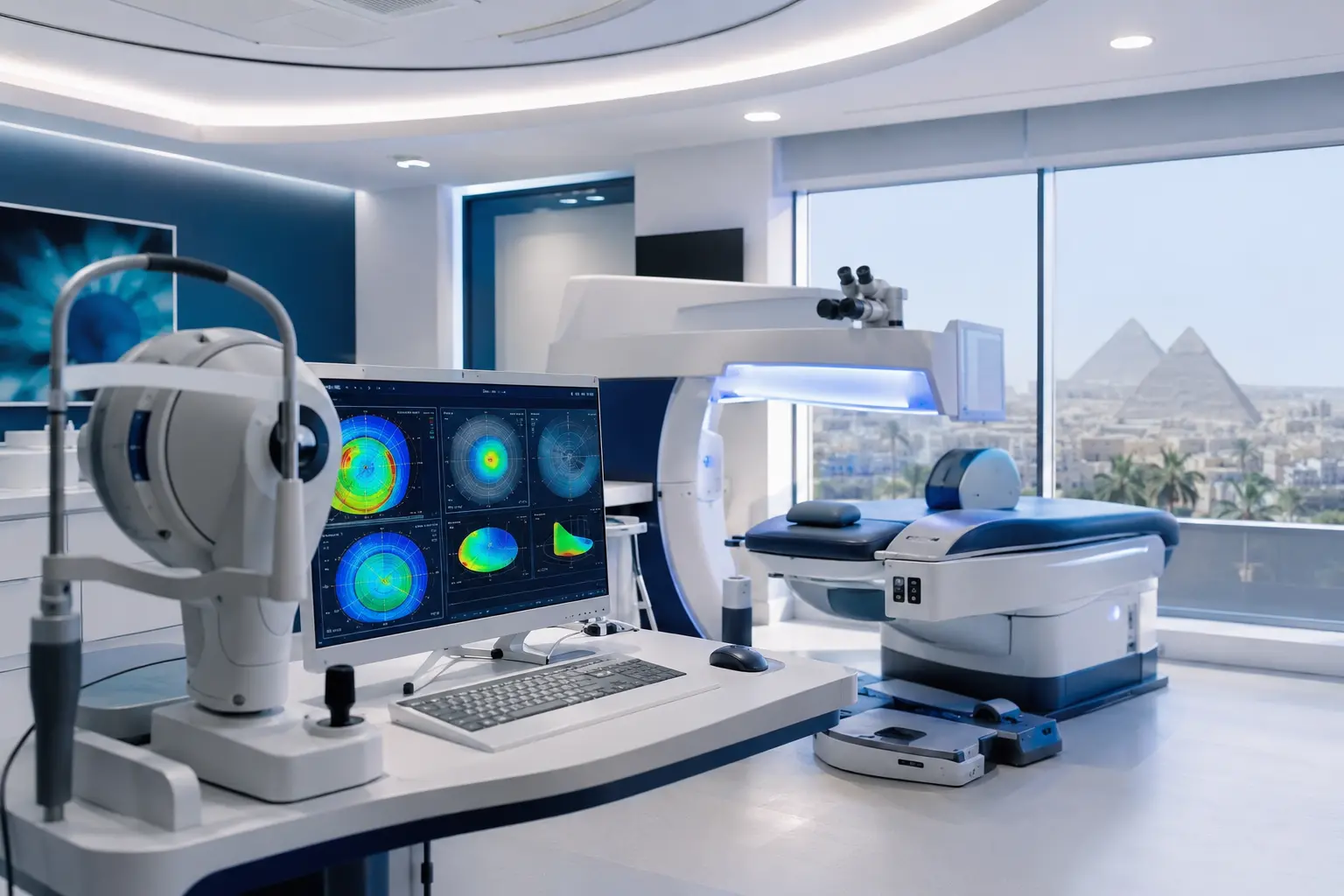
Laser flap creation generally offers tighter control over the intended flap parameters. At Cairo LASIK, the VICTUS femtosecond platform is paired with the TENEO 317 M2 excimer laser. The practical value is not the brand name alone; it is the ability to use predictable flap planning within a complete refractive strategy.
Precision does not make screening optional. A beautifully created flap does not protect an unsuitable cornea from ectasia, and advanced equipment cannot replace a stable refraction, reassuring tomography, appropriate tissue calculations and careful ocular-surface assessment.
- Programmed flap dimensions
- No mechanical blade
- Treatment planning remains case-specific
- Postoperative care is still essential
Recovery and visual results
Early recovery is usually rapid after either method. Many patients have useful vision the next day, although blur, fluctuating focus, dryness, glare and halos may occur during the healing period. The speed of recovery varies with prescription, tear film, treatment profile and individual healing.
For a suitable patient, the long-term refractive outcome depends more on accurate measurements, centration, excimer planning and healing response than on the flap tool by itself. FemtoLASIK should therefore be discussed as one part of the total procedure—not as a guarantee of a particular result.
How Dr Mohamed Anis chooses
The decision starts with refraction, corneal tomography, pachymetry, pupil and wavefront measurements when relevant, tear-film assessment and a dilated examination when indicated. The planned optical zone and estimated residual stromal bed are reviewed before a flap-based procedure is offered.
If a flap is appropriate, FemtoLASIK may offer the preferred level of flap control. If a flap is not the best fit, a surface procedure such as TransPRK may be considered. Some eyes should not have corneal laser surgery at all. A safe recommendation can therefore be FemtoLASIK, another technique, or no elective procedure.
Frequently asked questions
Does FemtoLASIK give better vision than LASIK?
Not automatically. Both can provide excellent vision in suitable patients. Final quality depends on candidacy, measurements, treatment planning, healing and the excimer profile as well as flap creation.
Is FemtoLASIK completely risk-free?
No. It avoids microkeratome-related flap creation but remains surgery. Dryness, inflammation, infection, flap problems, visual symptoms, under- or over-correction and ectasia are possible.
Can I choose based only on corneal thickness?
No. Thickness must be interpreted with corneal shape, posterior elevation, prescription, optical zone and residual-tissue calculations.
Medical sources and further reading
This article was reviewed against the following patient-information resources. Individual recommendations still depend on examination.