
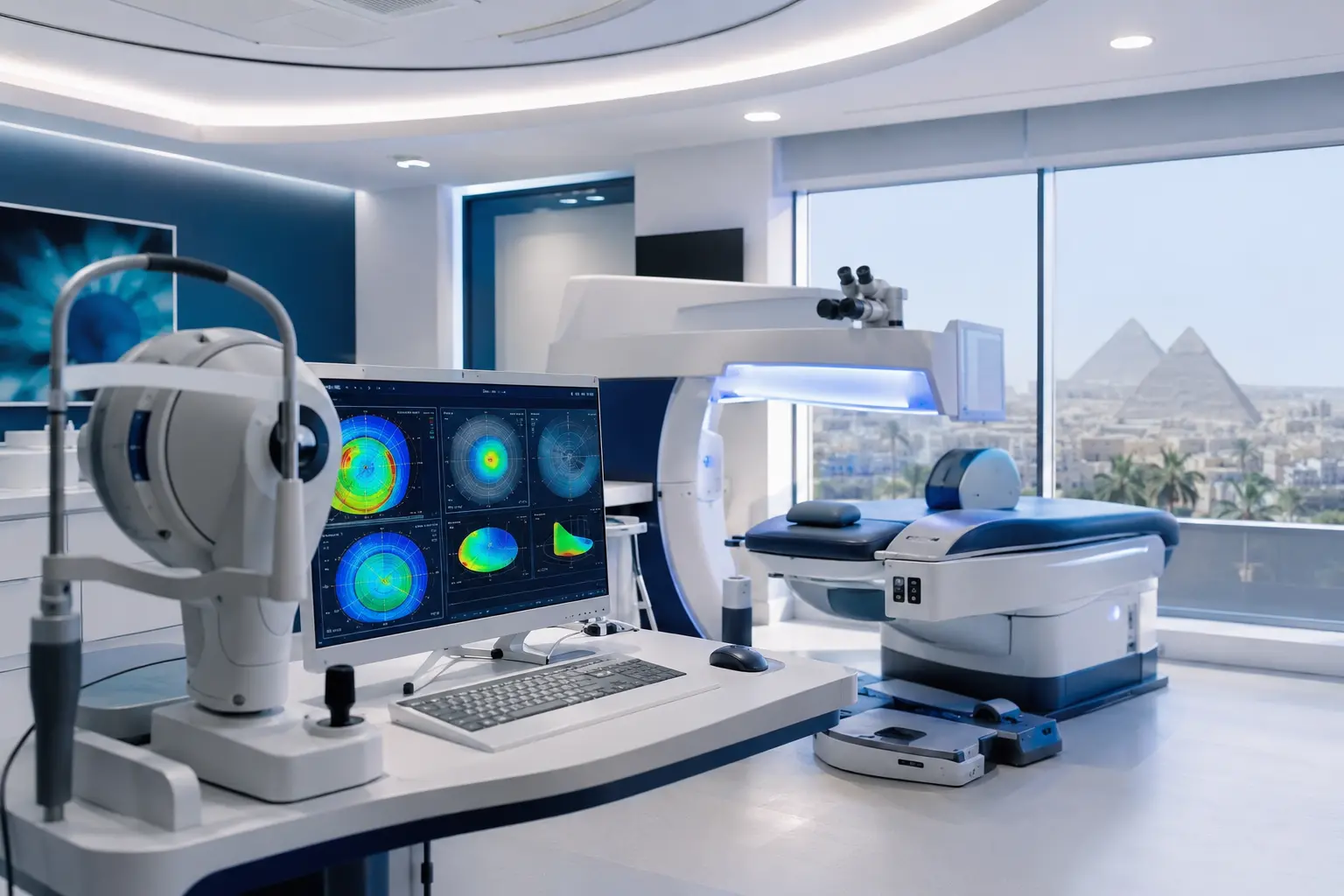
Why a glasses prescription is not the whole optical system
Sphere and cylinder describe the major refractive error, but the eye also has smaller higher-order aberrations that can affect contrast, glare and image quality. The cornea and internal lens may contribute different aberrations.
Customized planning tries to use additional measurements when they are stable and clinically meaningful. It cannot guarantee perfect night vision or remove every source of glare.
Wavefront-optimized treatment
A wavefront-optimized profile is not individualized from a full aberration map. It adjusts the ablation pattern, particularly toward the periphery, to reduce induced spherical aberration compared with older simple profiles.
For many regular eyes, this may be a sensible standard plan. Calling it non-custom does not mean inferior; the correct question is whether extra measurements change the treatment meaningfully.
Wavefront-guided treatment
Wavefront-guided planning measures how light travels through the entire optical system and can incorporate selected higher-order aberrations. Reliable capture requires a stable tear film, good fixation and compatible pupil conditions.
Because internal-lens aberrations can change with age, the surgeon must decide whether treating them on the cornea is desirable. Repeated measurements should agree before a permanent pattern is selected.
Topography-guided treatment
Topography-guided planning focuses on corneal elevation or curvature patterns and may help regularize selected corneal optical irregularities. It is different from using tomography merely to screen for ectasia risk.
Not every irregular map is safe to treat. Progressive keratoconus, insufficient tissue or poorly repeatable scans may require stabilization or non-laser correction rather than topography-guided ablation.
Measurement quality is the real foundation
Dry eye, recent contact-lens wear, poor fixation, eyelid pressure and tear debris can distort both wavefront and topography. Treating noise as a true optical abnormality can make a customized plan worse rather than better.
At Cairo LASIK, refraction, OCTAVIUS imaging and Zyoptix HD data are interpreted together when relevant. Scans may be repeated after ocular-surface treatment before the final plan.
How to judge a custom recommendation
Ask which measurement is abnormal, whether it was repeatable, how the proposed profile differs from an optimized treatment and what realistic benefit is expected. A clear answer should connect the technology to your specific eye.
Customization is valuable when it solves a defined optical problem. It should not be sold as an automatic upgrade or a guarantee against halos.
Useful questions for your consultation
Use these prompts to keep the discussion connected to your measurements, risks and visual goals.
- What finding makes customization useful in my eye?
- Were the scans repeatable?
- What benefit is expected over an optimized profile?
- Could the measured aberration come from my natural lens?
Frequently asked questions
Is Contoura the same as every topography-guided treatment?
Contoura is a brand-specific implementation. Other platforms have their own topography-guided workflows.
Does a custom profile always improve night vision?
No. It may help selected optical patterns, but dry eye, pupil size, residual error and neural adaptation also affect night vision.
Can Custom LASIK be FemtoLASIK?
Yes. Femto describes flap creation; custom describes the excimer treatment plan.
Why might scans be repeated?
The tear film and contact lenses can change measurements. Repeatability is essential before customized treatment.
Medical sources and further reading
This article was reviewed against the following patient-information resources. Individual recommendations still depend on examination.