
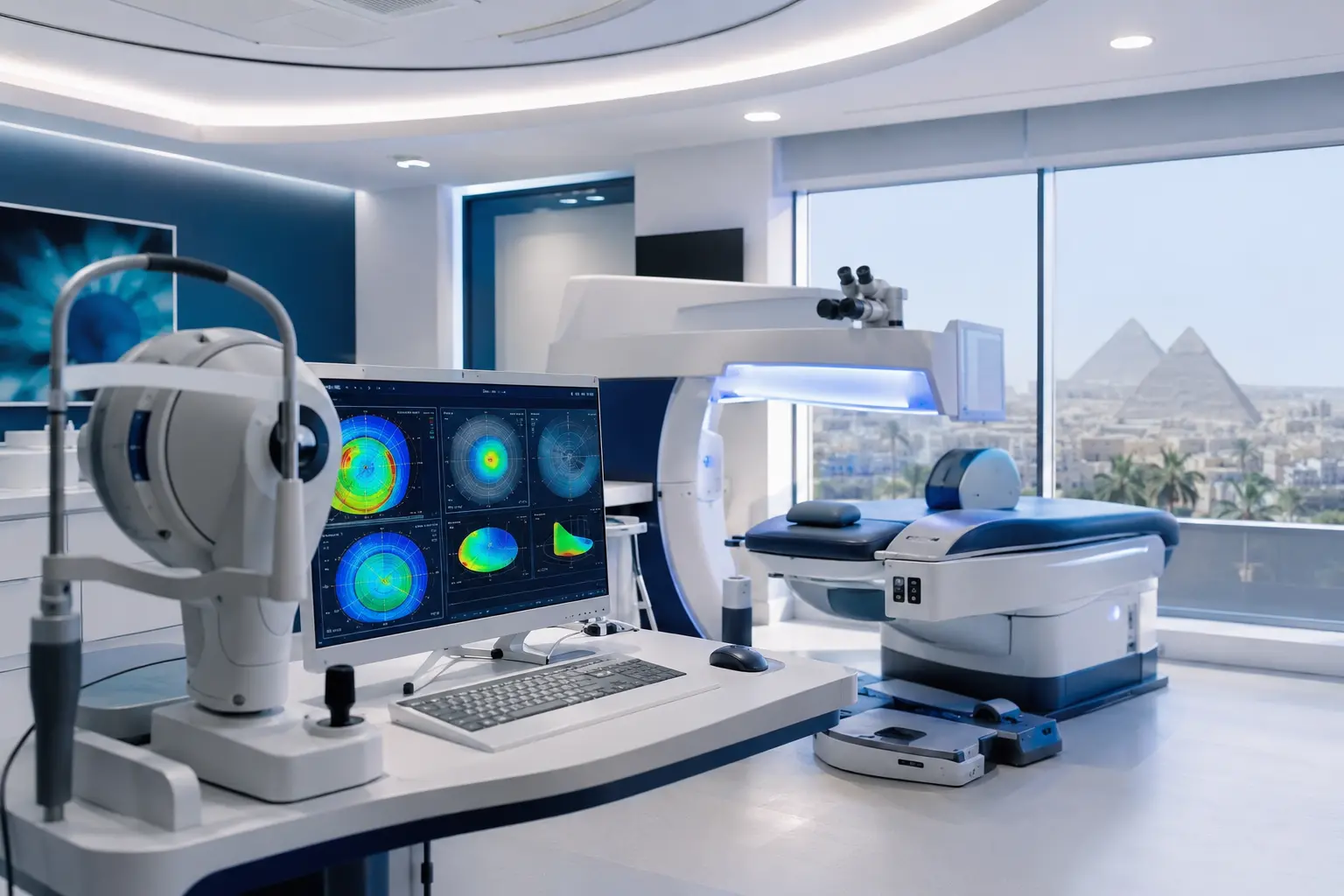
What astigmatism actually means
Astigmatism means the eye has different focusing power in different meridians. It can arise mainly from the cornea, from the natural lens or from both. The result may be blur, shadowing, squinting, eyestrain or reduced night clarity at distance and near.
A spectacle prescription describes astigmatism with cylinder power and axis. Laser planning also needs to know whether the corneal shape is regular and whether the measured axis is consistent across refraction, topography and wavefront testing.
How the laser treats regular astigmatism
The excimer laser applies a toric treatment pattern to reduce the difference between the main corneal meridians while also treating associated myopia or hyperopia. Eye tracking and correct alignment matter because rotating the treatment away from the intended axis reduces its effect.
The planned correction may be wavefront-optimized, wavefront-guided or topography-guided depending on the eye and platform. ‘Custom’ treatment is not automatically necessary for every cylinder; it should be selected when additional measurements offer a relevant advantage.
Regular versus irregular astigmatism
Regular astigmatism has organized principal meridians and is commonly corrected by glasses, toric contact lenses or refractive surgery. Irregular astigmatism cannot be described fully by one cylinder and axis. It can occur with keratoconus, corneal scars, prior surgery or surface disease.
Routine LASIK on a structurally abnormal cornea may worsen instability. When tomography is suspicious, the priority is diagnosis and stability rather than eliminating glasses. Cross-linking, specialty contact lenses or other corneal management may be more appropriate.
Why repeatable measurements matter
Dry eye, poor fixation, recent contact-lens wear and eyelid pressure can reduce measurement quality. If the cylinder magnitude or axis changes between tests, the cause should be investigated before a permanent laser profile is chosen.
Contact lenses may need to be stopped before final scans because they can temporarily alter corneal shape. The required interval depends on the lens type, wearing pattern and whether the maps have stabilized.
What results should you expect?
Many suitable patients achieve a substantial reduction in spectacle dependence, but small residual cylinder, regression or symptoms from other optical factors can remain. Night quality depends on tear film, pupil size, higher-order aberrations and neural adaptation as well as the cylinder number.
The consultation should define the realistic target and explain whether enhancement would be possible if a stable residual prescription remains. A promise of guaranteed perfect vision is not a responsible treatment plan.
Frequently asked questions
Can high astigmatism be treated with LASIK?
Sometimes, within the platform’s range and when corneal calculations remain safe. Higher cylinder requires especially reliable axis and corneal measurements.
Is irregular astigmatism the same as keratoconus?
No. Keratoconus is one cause of irregular astigmatism, but scars, surgery and ocular-surface problems can also produce irregularity.
Can astigmatism return?
A residual or later change is possible due to healing, regression or changes in the cornea or lens. Stability should be assessed before considering further treatment.
Medical sources and further reading
This article was reviewed against the following patient-information resources. Individual recommendations still depend on examination.