
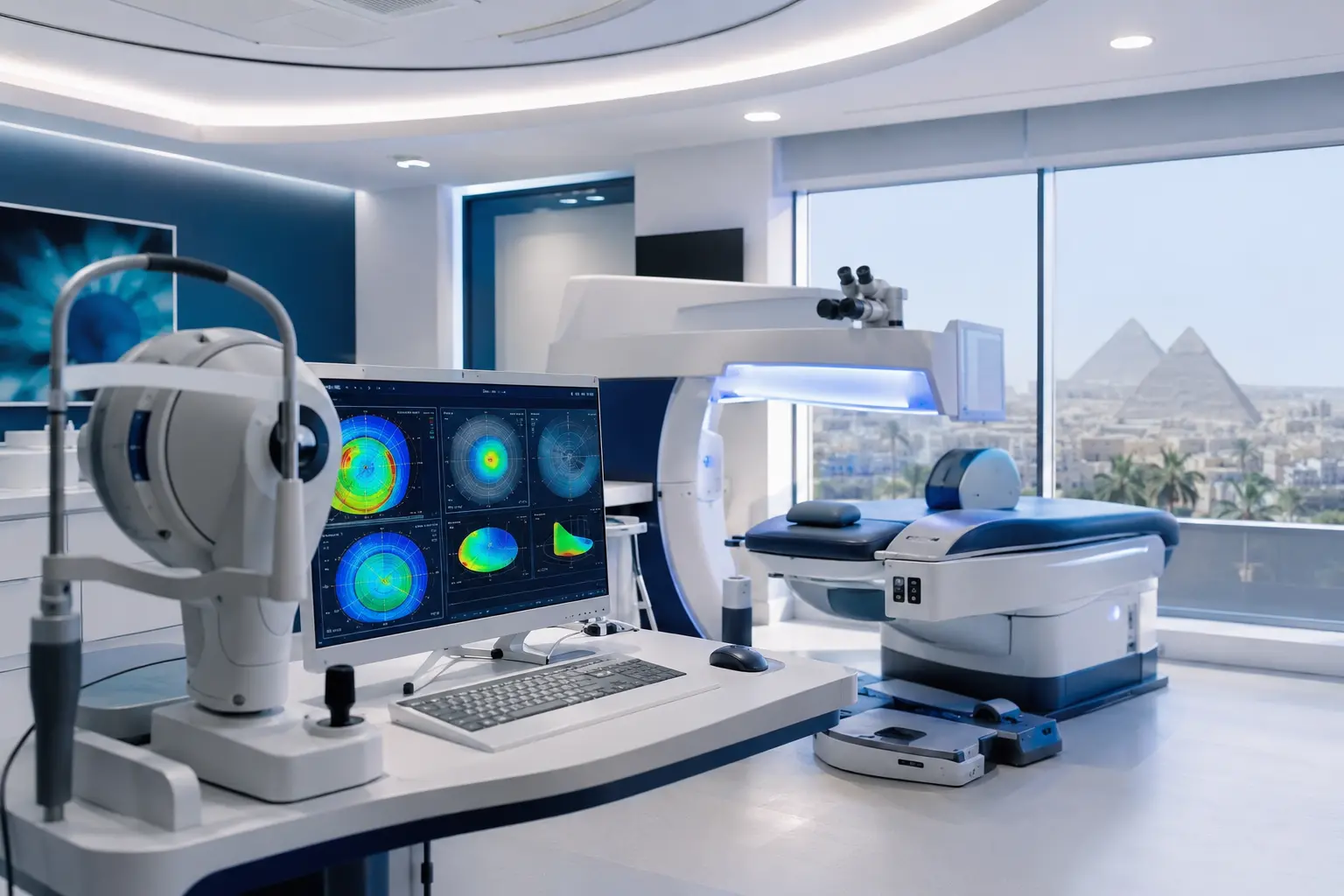
Permanent treatment does not mean a frozen eye
Excimer treatment permanently removes microscopic corneal tissue to change focusing power. That treated tissue does not simply grow back. However, the cornea can remodel during healing, and the rest of the eye continues to age. A later prescription can therefore develop even though the laser effect itself was permanent.
The risk is influenced by preoperative stability, age, prescription magnitude, corneal biomechanics and individual healing. Treating a changing prescription too early makes future change more likely.
Regression versus a new cause of blur
Regression describes a shift toward the original refractive error after treatment. Blur can also come from dry eye, irregular surface, early cataract, retinal disease or accommodation-related problems. Checking only the autorefractor can miss the true cause.
A complete review includes refraction, corneal maps, tear-film assessment and examination of the lens and retina. If blinking temporarily clears vision, the tear film may be contributing. If glare and contrast loss are disproportionate to refraction, the lens or optical quality deserves attention.
Why stable prescription matters before surgery
Young adults can continue to change after their eighteenth birthday. ‘Stable’ is judged from reliable previous prescriptions and clinical context rather than age alone. Pregnancy, breastfeeding, poorly controlled diabetes and some medications can also make refraction temporarily unreliable.
Waiting for stability may feel frustrating, but it protects the value of an elective procedure. The aim is to treat a settled target rather than chase a moving number.
Can an enhancement be done?
A second laser treatment may be possible when the residual prescription is stable, symptoms are significant, the ocular surface is healthy and corneal thickness and tomography remain suitable. The method may be flap-based or surface-based depending on timing and anatomy.
Enhancement is not automatic. A small prescription that gives acceptable function may be better managed with occasional glasses. If the blur comes from the natural lens, additional corneal laser may not solve it.
How to reduce avoidable uncertainty
Keep copies of your preoperative scans, refraction and treatment report. Attend the planned follow-up visits and avoid judging the result during an unstable dry-eye phase. If vision changes later, bring those records to the assessment.
Long-term care still includes routine eye examinations. LASIK reduces spectacle dependence; it does not prevent glaucoma, retinal disease, cataract or presbyopia.
Frequently asked questions
Does LASIK wear off after ten years?
There is no fixed expiry date. Later blur may reflect regression or normal changes in the eye and should be examined rather than assumed to be treatment failure.
Can I have LASIK twice?
Some patients can have an enhancement, but only after stable refraction, surface treatment and repeat corneal safety calculations.
Will pregnancy change LASIK results?
Hormonal and tear-film changes can temporarily alter refraction during pregnancy and breastfeeding. Elective treatment is usually postponed until stability returns.
Medical sources and further reading
This article was reviewed against the following patient-information resources. Individual recommendations still depend on examination.