
What the word Contoura actually means
Contoura is often used online as if it means any modern or customized LASIK. More precisely, it is a branded topography-guided workflow associated with compatible Alcon WaveLight diagnostic and excimer systems. The access step may still be FemtoLASIK: a femtosecond laser creates the flap and the excimer laser applies the guided correction underneath.
That distinction matters when comparing clinics. Wavefront-guided, topography-guided and wavefront-optimized profiles use different inputs and are not interchangeable marketing labels. Ask which exact diagnostic system and laser profile will be used for your own eyes.
How corneal topography guides treatment
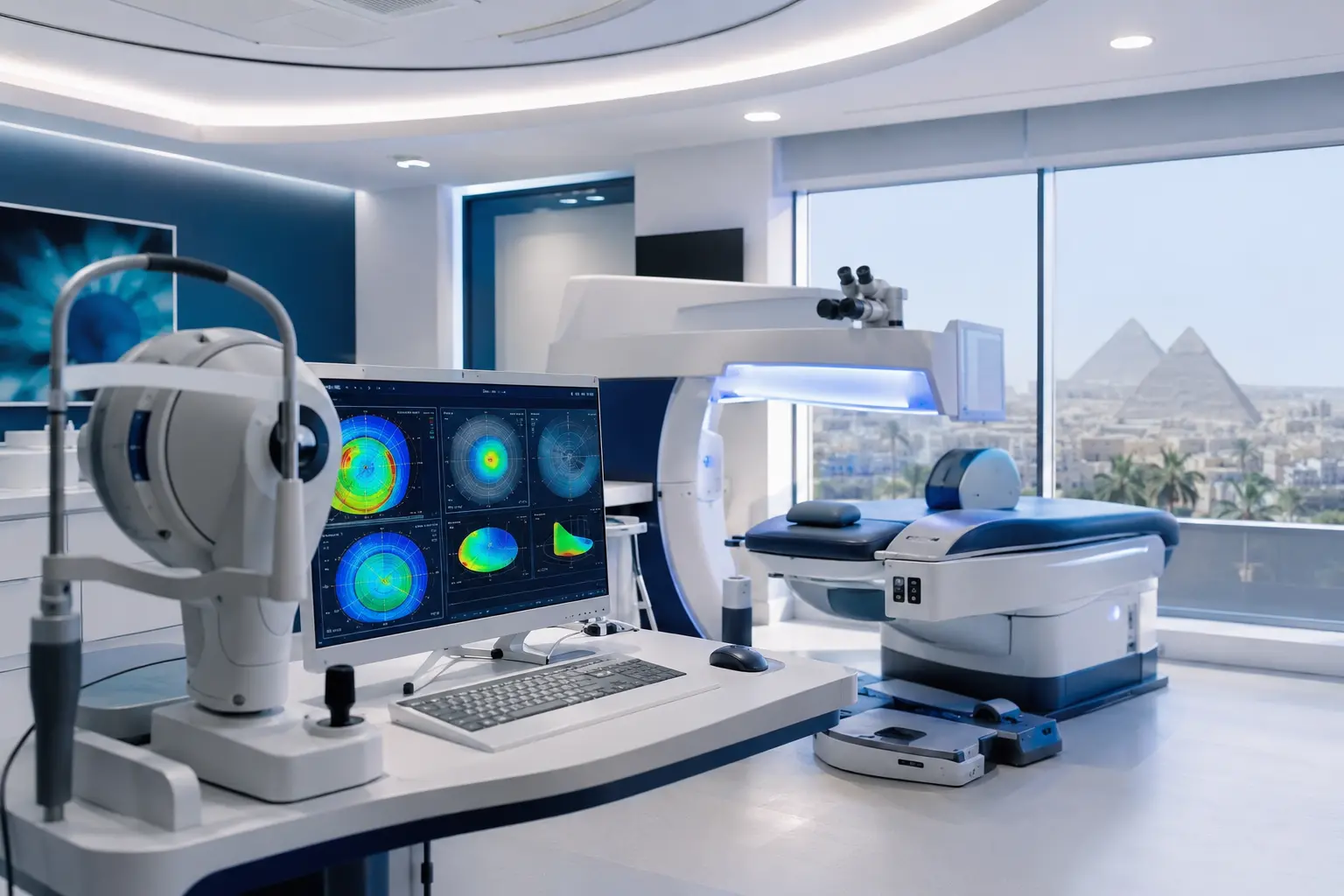
A compatible topographer measures elevation, curvature, pupil position and other features across the front of the cornea. Alcon states that its Topolyzer Vario captures 22,000 elevation points. The software can transfer reliable map and alignment data into treatment planning.
A large number of data points does not make a poor scan trustworthy. Dry eye, recent contact-lens wear, unstable fixation, eyelid pressure or inconsistent acquisition can distort maps. The surgeon should repeat measurements and reconcile them with refraction, tomography, pachymetry and the clinical examination.
- Stable subjective and objective refraction
- Repeatable corneal maps
- Healthy, stable tear film
- Acceptable corneal shape and tissue calculation
Who may be considered for topography-guided LASIK?
Basic candidacy remains the starting point: adult age, stable prescription, a cornea without suspicious ectatic features, sufficient tissue for the intended optical zone and an ocular surface that permits accurate measurements and predictable healing.
A guided profile may be considered when the measured corneal optics provide a meaningful planning target. The final decision must stay within the approval and technical limits of the specific platform. A patient who is unsuitable for standard LASIK is not made suitable simply by adding a guided-treatment name.
Potential benefits and realistic limits
Topography-guided planning is designed to combine refractive correction with measured corneal-surface information. In selected eyes, the goal may include improving the regularity of the optical surface or avoiding the induction of unnecessary aberrations. The expected gain should be explained in terms of the individual measurements rather than a guaranteed line of vision.
Dryness, glare, halos, fluctuating vision, under- or over-correction, infection, inflammation and ectasia remain possible. Corneal treatment also cannot prevent presbyopia, cataract, retinal disease or future prescription change.
Contoura is not the same as every Custom LASIK
Custom LASIK is an umbrella term. A wavefront-guided plan uses optical measurements from the eye as a whole. A topography-guided plan prioritizes the measured corneal surface. A wavefront-optimized plan is designed to preserve a favorable corneal optical shape without treating a patient-specific map in the same way.
One is not automatically superior. If the corneal surface is regular and the extra measurements do not create a useful target, an optimized treatment may be entirely appropriate. If the cornea is suspicious, no excimer profile may be appropriate.
How to evaluate a Contoura consultation
A useful consultation shows you the logic: whether the maps repeat, how the prescription and topography are reconciled, how much tissue is planned, which platform will deliver treatment and why this profile is expected to help. It should also explain alternatives and the option of no surgery.
Do not choose from the label alone. The value of any guided treatment depends on data quality, correct registration, platform limits, surgical experience, surface preparation and follow-up.
Useful questions for your consultation
Use these prompts to keep the discussion connected to your measurements, risks and visual goals.
- Which device captured my maps?
- Were the measurements repeated and consistent?
- Why does this profile add value for my eye?
- What alternatives remain medically reasonable?
Frequently asked questions
Is Contoura bladeless?
Contoura describes the excimer treatment profile, not flap creation. It may be combined with a femtosecond-created flap, but those are separate parts of the operation.
Does Contoura guarantee better than 20/20 vision?
No. No ethical refractive-surgery plan can guarantee a particular acuity or freedom from visual symptoms.
Can Contoura treat an irregular or weak cornea?
Not automatically. Irregularity may require further diagnosis, and suspected ectasia can make elective laser correction unsafe.
Is topography-guided treatment the same as wavefront-guided treatment?
No. Topography emphasizes the corneal surface; wavefront measures optical aberrations through the eye. The inputs and treatment logic differ.
Medical sources and further reading
This article was reviewed against the following patient-information resources. Individual recommendations still depend on examination.