
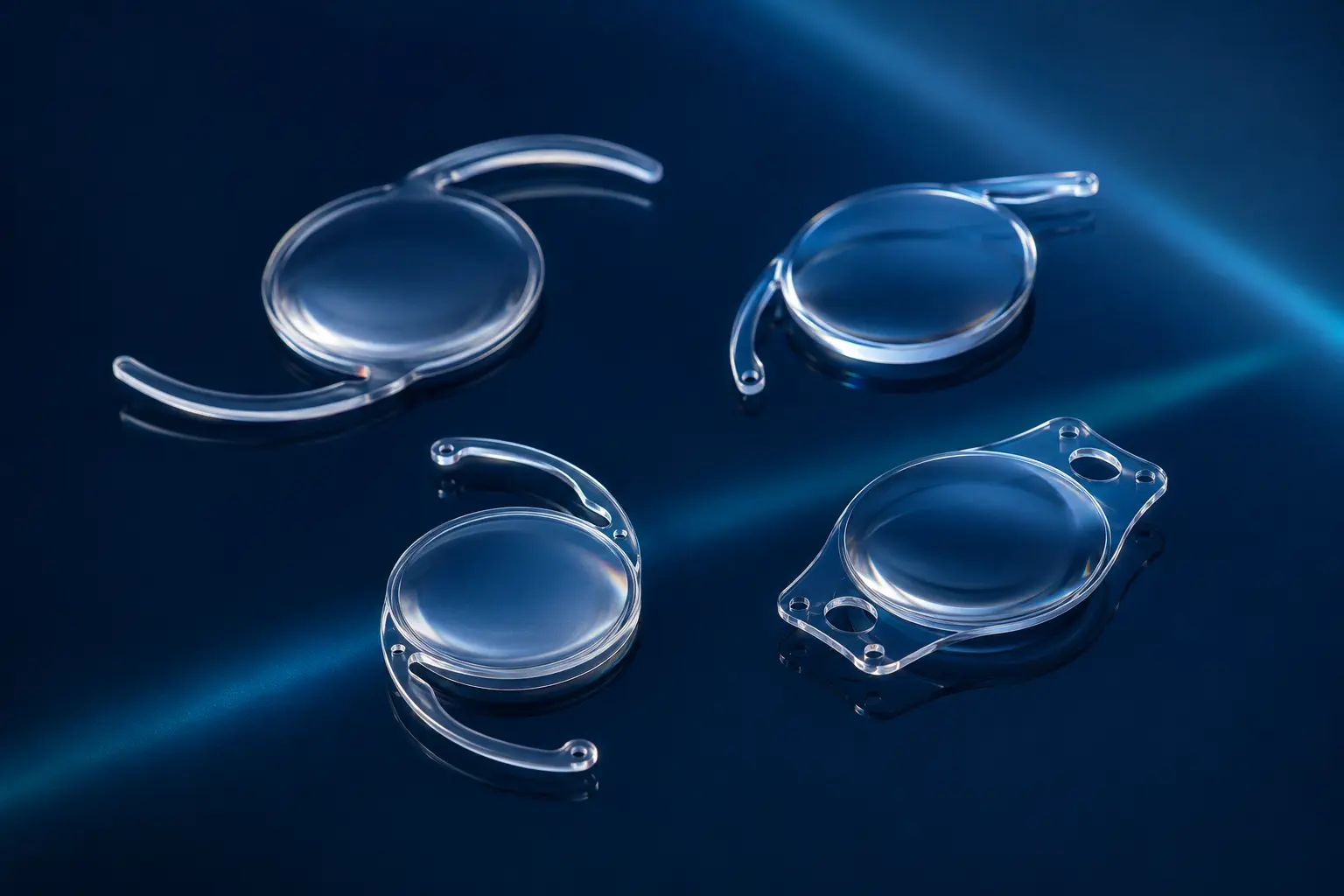
How three focal ranges are created
Diffractive or other optical zones distribute incoming light to distance, intermediate and near foci. The brain learns to prioritize the image needed for the task.
The technology increases range but does not recreate the smooth accommodation of a young natural lens. Performance changes with lighting, pupil, task distance and ocular quality.
What glasses independence really means
Many patients perform daily distance, screen and reading tasks with less reliance on glasses. Very small print, prolonged reading, dim restaurants or specialized work may still benefit from spectacles.
Any claim of guaranteed complete freedom ignores residual refractive error, individual optics and changing task demands.
Halos, glare and contrast
Rings around lights, starbursts and reduced low-contrast clarity are expected optical trade-offs. They often become less intrusive over time, but may persist.
Dry eye and residual astigmatism can amplify symptoms and should be treated. A patient with demanding night driving may prefer a different strategy.
Who is a careful candidate?
Healthy macula and optic nerve, regular corneal optics, stable tear film and realistic expectations support success. Corneal topography and macular OCT can be important even when routine examination seems normal.
Significant epiretinal membrane, macular degeneration, advanced glaucoma, irregular astigmatism or severe surface disease may shift the recommendation toward monofocal or another design.
If the result is not comfortable
The surgeon checks dry eye, residual prescription, IOL centration, capsule clarity, macula and neural adaptation. Treatment may include surface care, glasses, laser correction, YAG when truly indicated or rarely IOL exchange.
YAG should not be rushed if lens exchange is being considered because an open posterior capsule can complicate exchange surgery.
Useful questions for your consultation
Use these prompts to keep the discussion connected to your measurements, risks and visual goals.
- Is my macular OCT normal?
- How much night driving do I do?
- Which reading distance is targeted?
- What is the plan if halos are intolerable?
Frequently asked questions
Will halos disappear completely?
They often lessen with time but can persist. Night-driving priorities should be discussed before surgery.
Can a trifocal lens correct astigmatism?
A toric trifocal model may correct suitable regular corneal astigmatism.
Can I read my phone without glasses?
Many patients can, but near performance depends on chosen lens, distance, light and residual prescription.
What if I have retinal disease?
Retinal disease may reduce contrast and satisfaction; a simpler optical design is often considered.
Medical sources and further reading
This article was reviewed against the following patient-information resources. Individual recommendations still depend on examination.
- U.S. FDA — Phakic intraocular lens risks
- National Eye Institute — Cataracts and intraocular lenses
- American Academy of Ophthalmology — Cataract surgery
- Alcon — Cataract lens portfolio
- Johnson & Johnson Vision — TECNIS Eyhance
- Johnson & Johnson Vision — TECNIS PureSee
- Bausch + Lomb Surgical — Cataract portfolio