
Start with the visual target
Before selecting a brand or category, decide which distances matter: driving, television, desktop, mobile, reading or fine near work. Dominance, occupation and willingness to use glasses shape the target.
Biometry predicts IOL power but cannot guarantee an exact endpoint. Corneal astigmatism and previous LASIK add complexity.
Monofocal and monovision strategies
A monofocal lens provides its clearest focus around one target, commonly distance. Reading glasses are then expected. Both eyes can also be set differently for mini-monovision when the patient accepts its compromises.
Monofocal optics are generally less likely to create multifocal halos and are often robust when macular, optic-nerve or corneal disease limits contrast.
Toric lenses
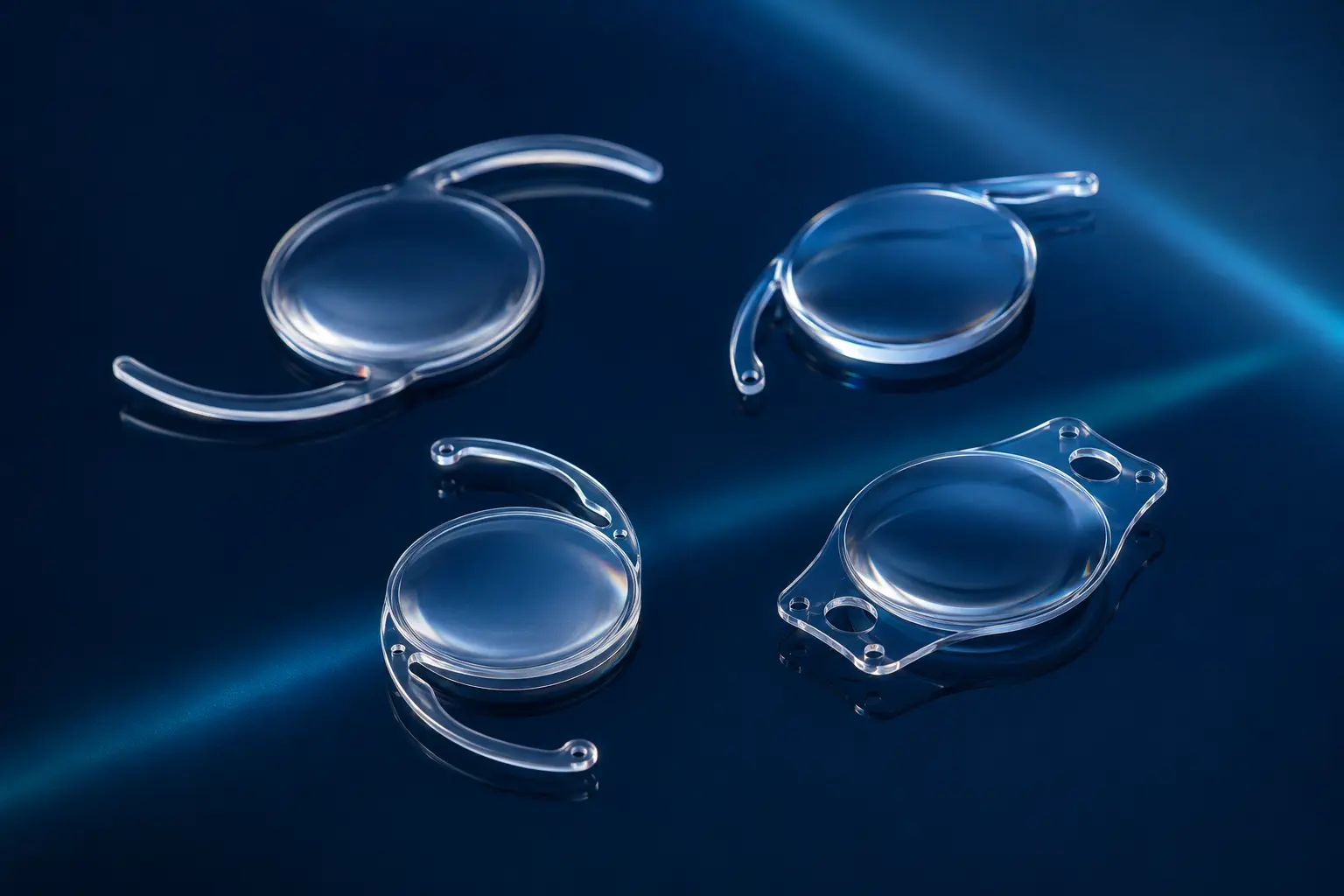
A toric IOL incorporates cylinder correction for regular corneal astigmatism. It still belongs to another focal category: monofocal toric, EDOF toric or multifocal toric.
Accurate corneal measurement and rotational alignment are essential. Ocular-surface disease and irregular astigmatism can make planning unreliable.
Enhanced monofocal and EDOF
Enhanced monofocal designs aim to improve intermediate range while retaining a monofocal-like optical profile. EDOF designs extend the focus more broadly, often supporting distance and intermediate vision.
Near reading may still need glasses. Halos and contrast effects vary by design; ‘EDOF’ is a category, not one identical optical behaviour.
Multifocal and trifocal lenses
These lenses divide or distribute light to create more than one focal range. They can reduce dependence on reading and distance glasses in well-selected eyes.
Trade-offs include halos, glare, reduced contrast, waxy vision or adaptation time. Significant dry eye, irregular cornea, macular disease, glaucoma damage or unrealistic expectations may make them poor choices.
Why the best lens is personal
Retinal OCT, corneal topography, tear-film assessment, pupil behaviour, optic-nerve health, biometric accuracy and lifestyle determine how much range the eye can use.
No premium category is universally superior. The right lens is the one whose strengths match the patient and whose optical compromises the patient understands.
Useful questions for your consultation
Use these prompts to keep the discussion connected to your measurements, risks and visual goals.
- Which distances matter most to me?
- How much astigmatism is corneal?
- Is my macula and optic nerve suitable for a range-extending lens?
- What glasses will I probably still need?
Frequently asked questions
Which lens guarantees no glasses?
None. Presbyopia-correcting lenses reduce dependence but cannot guarantee complete freedom at every distance.
Is toric the same as multifocal?
No. Toric corrects astigmatism; focal design determines distance and near range. A lens can be both.
Can I have multifocal after LASIK?
Sometimes, but corneal regularity, historical data, calculation accuracy and visual quality need careful review.
Can an IOL be changed?
Sometimes, but exchange is additional intraocular surgery with its own risks.
Medical sources and further reading
This article was reviewed against the following patient-information resources. Individual recommendations still depend on examination.
- U.S. FDA — Phakic intraocular lens risks
- National Eye Institute — Cataracts and intraocular lenses
- American Academy of Ophthalmology — Cataract surgery
- Alcon — Cataract lens portfolio
- Johnson & Johnson Vision — TECNIS Eyhance
- Johnson & Johnson Vision — TECNIS PureSee
- Bausch + Lomb Surgical — Cataract portfolio