
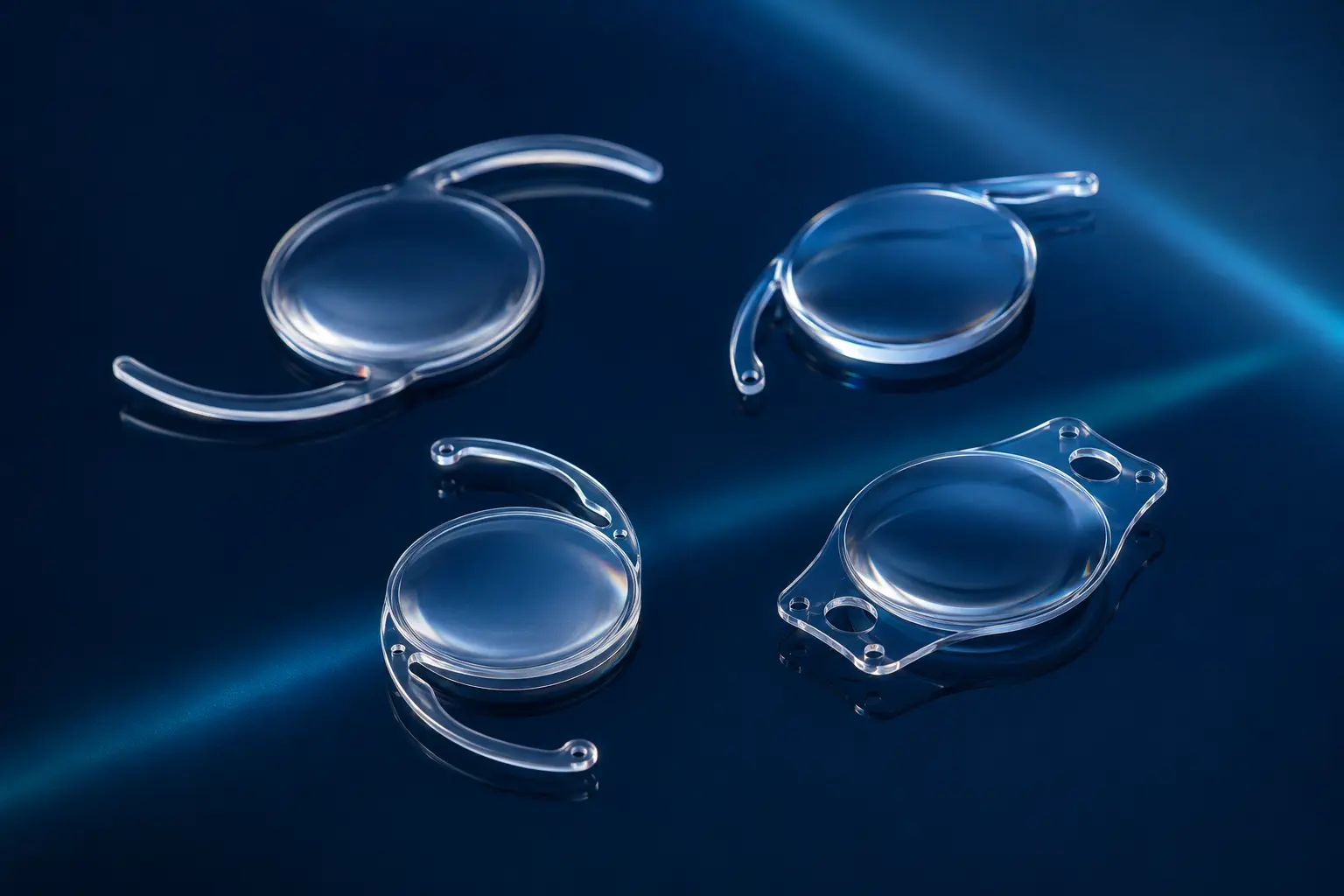
Monofocal: one main target
Distance targeting usually gives clear far vision, with reading glasses expected. Near targeting does the reverse. Mini-monovision can broaden binocular range by leaving one eye mildly near-focused.
This strategy often provides robust contrast and fewer lens-induced halos, which may suit night drivers or eyes with other disease.
Multifocal and trifocal: several focal zones
These optics send light to more than one focus. Trifocal designs specifically aim to cover distance, intermediate and near tasks.
Because light is distributed, patients may notice rings, halos, glare or reduced contrast. Adaptation differs and not every dissatisfied eye simply ‘gets used to it.’
EDOF: an extended focal corridor
EDOF designs elongate the focus rather than rely only on separate focal points. Many prioritize distance and computer/intermediate range.
Near performance varies, and fine print may need glasses. Dysphotopsia can occur, though its pattern may differ from multifocal lenses.
Who may not suit a range-extending lens?
Irregular corneal optics, unstable dry eye, macular disease, advanced glaucoma, optic neuropathy or unrealistic expectations can reduce satisfaction. Previous refractive surgery makes power prediction and optical assessment more complex.
A patient who must have the cleanest possible night contrast may accept reading glasses in exchange for monofocal simplicity.
A decision based on tasks, not marketing tiers
List the distances used for driving, desktop, phone, books and hobbies. Discuss lighting, tolerance of glasses and night-work demands.
The surgeon then matches ocular health and measurements to the least compromising strategy. ‘Premium’ is a commercial category, not a biological guarantee.
Useful questions for your consultation
Use these prompts to keep the discussion connected to your measurements, risks and visual goals.
- How important is night driving?
- Which near distance do I actually use?
- What optical symptoms are likely with this design?
- What is the fallback if I remain dissatisfied?
Frequently asked questions
Which lens gives the sharpest night vision?
Many patients favour monofocal optics for contrast and fewer halos, but individual eye health and residual error matter.
Will EDOF let me read tiny print?
Not always. It often emphasizes intermediate range; reading glasses may still be needed.
Do multifocal halos disappear?
They often become less noticeable with adaptation, but can persist and occasionally be intolerable.
Can one eye have a different design?
Mix-and-match strategies exist, but binocular balance and consent require careful testing and planning.
Medical sources and further reading
This article was reviewed against the following patient-information resources. Individual recommendations still depend on examination.
- U.S. FDA — Phakic intraocular lens risks
- National Eye Institute — Cataracts and intraocular lenses
- American Academy of Ophthalmology — Cataract surgery
- Alcon — Cataract lens portfolio
- Johnson & Johnson Vision — TECNIS Eyhance
- Johnson & Johnson Vision — TECNIS PureSee
- Bausch + Lomb Surgical — Cataract portfolio