
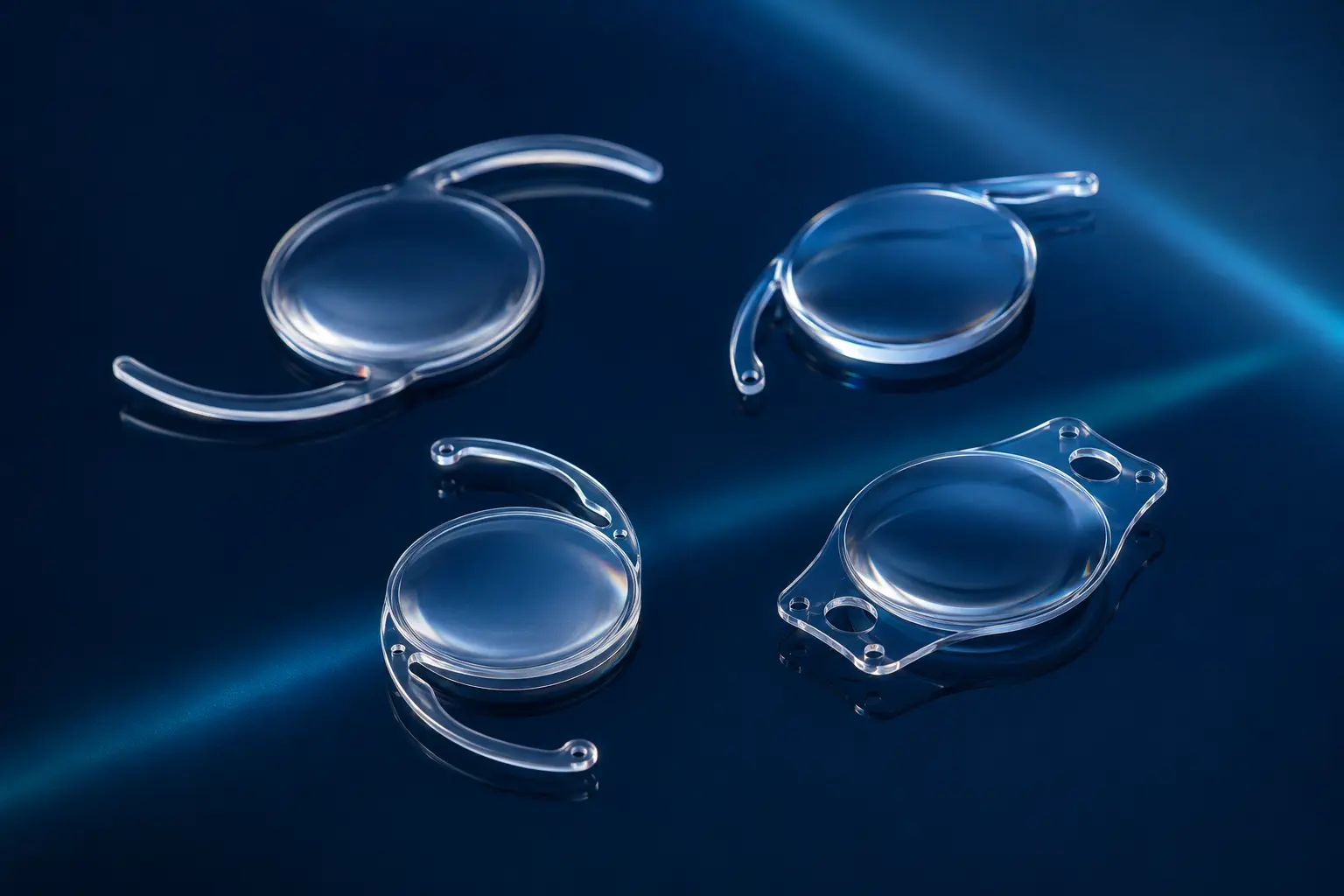
What toric corrects
Toric IOLs address corneal astigmatism that will remain after the natural lens is removed. They do not automatically correct irregular astigmatism, retinal blur or every source of cylinder.
The lens can be monofocal, EDOF or multifocal in focal design; toric describes only the astigmatism component.
Measurements before surgery
Keratometry, topography or tomography, biometry and ocular-surface evaluation are compared. Posterior corneal astigmatism and surgically induced astigmatism may be incorporated into calculations.
Dry eye, contact-lens warpage and inconsistent axes should be treated or remeasured. A permanent toric plan should not be based on one unreliable scan.
Marking and alignment
The calculated axis must be transferred accurately to the eye while accounting for posture-related cyclotorsion. Image guidance or physical marking may be used.
At the end of surgery, the IOL is rotated to the planned axis after viscoelastic removal. Capsular healing then helps stabilize it.
Rotation and residual astigmatism
Rotation reduces the intended cylinder effect. If residual astigmatism is significant, the surgeon checks refraction, lens axis, corneal measurements and timing.
Options can include waiting for stability, glasses, corneal laser, relaxing incisions or IOL repositioning. Early repositioning may be considered when clear misalignment is the cause.
Who may not benefit
Very irregular corneal astigmatism, unstable measurements, uncertain capsular support or severe ocular comorbidity can reduce benefit. A toric lens can correct one optical component but cannot overcome macular or optic-nerve disease.
The goal is meaningful reduction of cylinder and glasses dependence, not a guaranteed zero reading.
Useful questions for your consultation
Use these prompts to keep the discussion connected to your measurements, risks and visual goals.
- Are my corneal axes repeatable?
- How much posterior corneal cylinder is included?
- What focal design is the toric lens?
- How will axis and postoperative rotation be checked?
Frequently asked questions
Can a toric IOL also be trifocal?
Yes. Toric correction and focal-range design are separate features and can be combined in some models.
Does every astigmatism need toric IOL?
No. Degree, regularity, axis, incision and patient goals influence benefit.
Can the lens rotate later?
Most rotation occurs early, but late movement can occur with capsular or zonular changes.
Will I still need glasses?
Possibly, because residual cylinder, spherical error and focal target all affect glasses use.
Medical sources and further reading
This article was reviewed against the following patient-information resources. Individual recommendations still depend on examination.
- U.S. FDA — Phakic intraocular lens risks
- National Eye Institute — Cataracts and intraocular lenses
- American Academy of Ophthalmology — Cataract surgery
- Alcon — Cataract lens portfolio
- Johnson & Johnson Vision — TECNIS Eyhance
- Johnson & Johnson Vision — TECNIS PureSee
- Bausch + Lomb Surgical — Cataract portfolio