
The simplest comparison
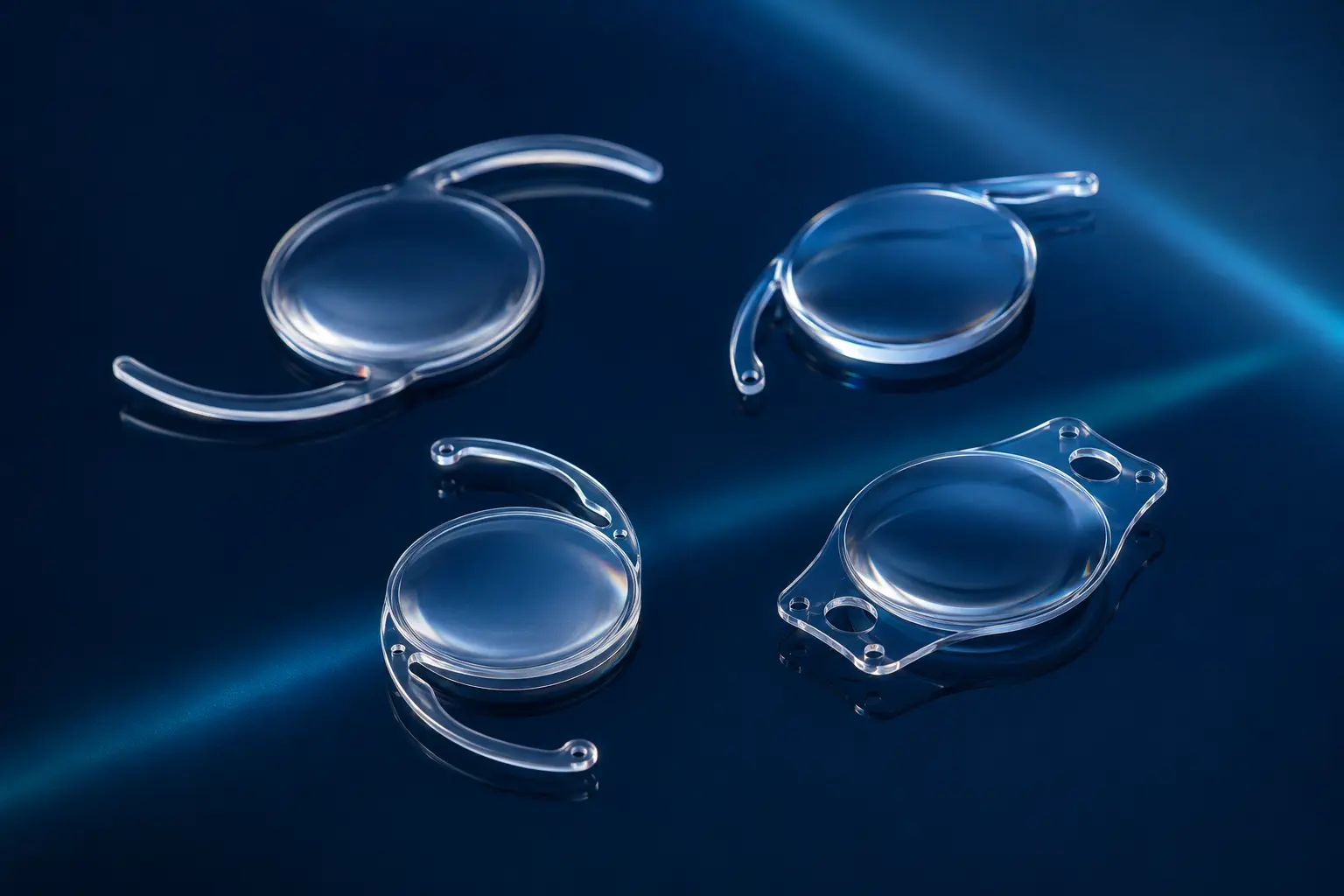
Eyhance stays closest to a monofocal strategy. Vivity extends the continuous focus farther toward intermediate and some near. PanOptix deliberately creates three focal zones to pursue the broadest spectacle-free range.
This is not a ranking. Each step toward more range changes the way light is used and the importance of retinal health, corneal regularity and tolerance of night symptoms.
Near vision and reading glasses
PanOptix is most directly designed for near as well as distance and intermediate tasks. Vivity may provide functional near for larger print or everyday tasks, while Eyhance generally leaves a greater need for reading glasses.
Actual performance depends on target refraction, pupil, lighting, print size and binocular adaptation. A promotional reading-distance number is not a promise for every patient.
Night driving, halos and contrast
A trifocal can produce rings or halos around lights because it distributes light among focal zones. Vivity and Eyhance use different strategies and may be discussed when night-quality priorities are high, but no intraocular lens is free of optical symptoms.
A patient who drives professionally at night may make a different choice from a patient whose main goal is reading a phone without glasses. The consultation should document that priority.
Toric versions and residual prescription
All three families have astigmatism-correcting options in selected markets. A toric result still depends on surface stability, posterior-corneal assessment, calculation and axis alignment.
Small residual sphere or cylinder can be more noticeable with a premium optic. Glasses, corneal laser enhancement or other management may be considered only after the eye stabilises.
A practical decision framework
Choose PanOptix when broad range is a high priority and the eye and expectations suit a trifocal. Consider Vivity when distance and intermediate are central and some near is desirable without choosing a trifocal. Consider Eyhance when a monofocal-style approach with a modest intermediate gain fits the risk-benefit discussion.
The final choice follows macular OCT, corneal imaging, biometry, glaucoma assessment, ocular-surface treatment and a realistic conversation about glasses—not popularity on social media.
Useful questions for your consultation
Use these prompts to keep the discussion connected to your measurements, risks and visual goals.
- Which distances matter most to me?
- How much night driving do I do?
- Is the macular OCT normal?
- What glasses might I still need?
Frequently asked questions
Which lens is best for phone reading?
PanOptix is most directly designed for near, but lighting and print size still matter and glasses may occasionally be needed.
Which is best for night driving?
There is no automatic winner. Eyhance or Vivity may be considered when a simpler photic profile is prioritised, but individual symptoms vary.
Can I have a different lens in each eye?
Mix-and-match strategies exist but require careful binocular planning and counselling; they are not suitable for everyone.
Which costs the most?
Prices vary by model, toric power, hospital and distributor. Optical suitability should be decided before comparing the quote.
Medical sources and further reading
This article was reviewed against the following patient-information resources. Individual recommendations still depend on examination.
- U.S. FDA — Phakic intraocular lens risks
- National Eye Institute — Cataracts and intraocular lenses
- American Academy of Ophthalmology — Cataract surgery
- Alcon — Cataract lens portfolio
- Johnson & Johnson Vision — TECNIS Eyhance
- Johnson & Johnson Vision — TECNIS PureSee
- Bausch + Lomb Surgical — Cataract portfolio