
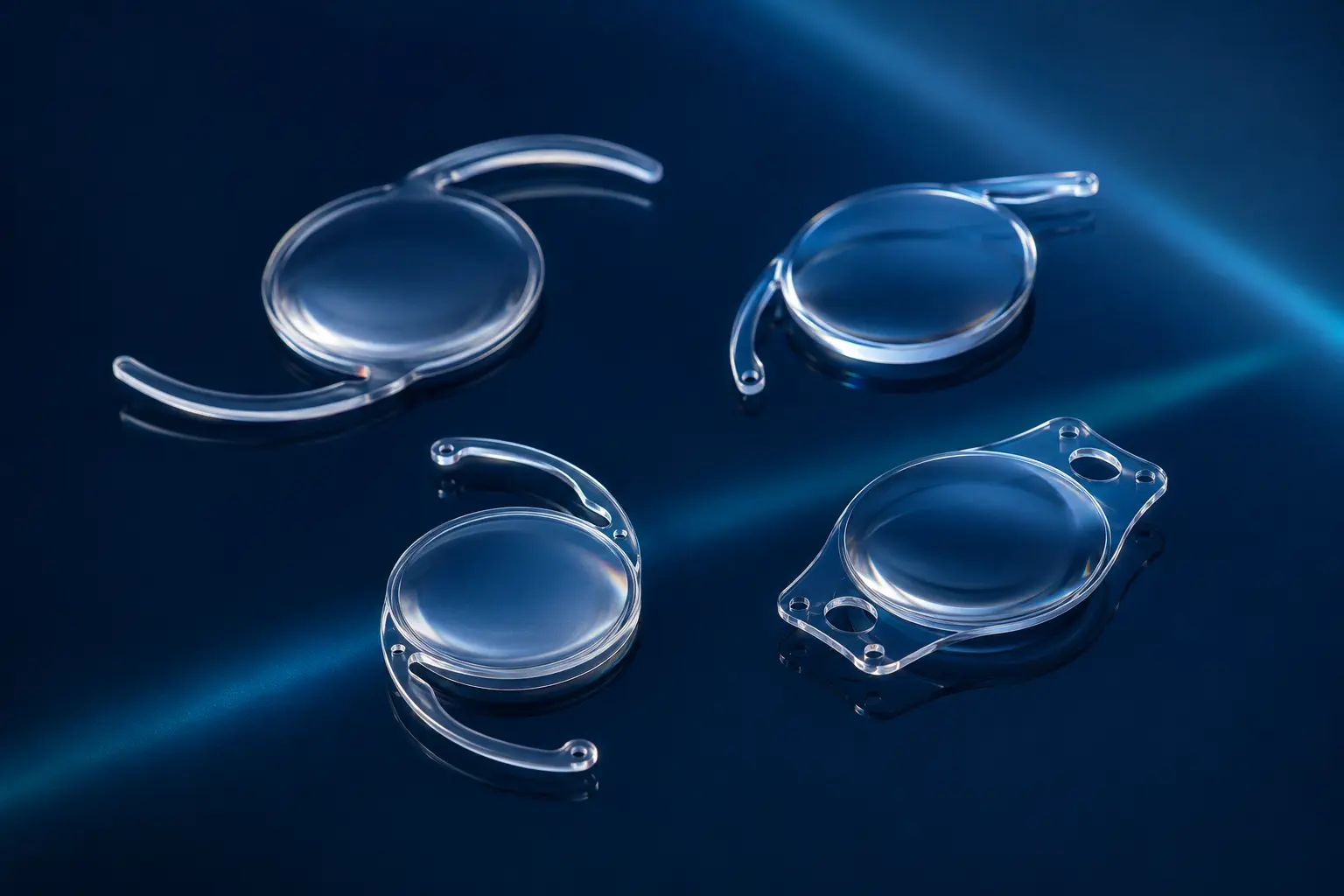
Clareon and AcrySof IQ are material platforms
Clareon and AcrySof IQ describe lens-material and platform families rather than a single range of vision. The optical design carried on that platform—monofocal, Vivity or PanOptix—determines how focus is distributed.
A preloaded delivery system can affect surgical handling, but it does not turn a monofocal into a premium-range lens. Patients should ask for the full model description, not only the manufacturer.
Clareon Monofocal and Clareon Toric
Clareon Monofocal is commonly targeted for clear distance vision in both eyes or for a planned monovision strategy in suitable patients. Reading glasses remain likely when both eyes are targeted for distance.
Clareon Toric adds astigmatism correction. Its value depends on repeatable corneal measurements, posterior-corneal estimation, correct axis placement and rotational stability—not simply on having cylinder in a spectacle prescription.
Vivity and Vivity Toric
Vivity is a non-diffractive EDOF design that uses wavefront shaping to broaden the visual range. Its strongest practical aim is good distance and intermediate function with some functional near, but small print may still require glasses.
It is often discussed with patients who want more range than a standard monofocal but do not want the same light-distribution strategy as a trifocal. Dysphotopsia can still occur, and retinal, corneal or optic-nerve disease may limit performance.
PanOptix and PanOptix Toric
PanOptix is a trifocal design intended to provide distance, intermediate and near focal points. It can reduce spectacle dependence across more tasks than a monofocal, but it redistributes light and may produce halos, glare or reduced contrast, especially at night.
PanOptix Toric combines the trifocal optic with correction for regular corneal astigmatism. Precise biometry and axis planning are essential because residual sphere, cylinder or dry eye can reduce the quality of a multifocal result.
Which Alcon lens fits which patient?
The model is matched to the patient's retina, cornea, visual priorities, occupation and tolerance for optical symptoms. A healthy macula and regular cornea support a broader range of choices; irregular astigmatism, advanced glaucoma or macular disease may favour a simpler optic.
Previous corneal laser treatment requires adjusted measurements and calculations. The target is not the most expensive lens but the most predictable match between anatomy and expectations.
Useful questions for your consultation
Use these prompts to keep the discussion connected to your measurements, risks and visual goals.
- Which exact Alcon model is planned?
- Why is its focal range appropriate for me?
- Do I need toric correction?
- What night-vision symptoms are realistic?
Frequently asked questions
Is Clareon the same as PanOptix?
No. Clareon is a material/platform family; PanOptix is a trifocal optical design available on that platform.
Is Vivity a multifocal lens?
It is generally classified as a non-diffractive extended-depth-of-focus lens, not a trifocal.
Will PanOptix eliminate reading glasses?
It may substantially reduce dependence, but no lens can guarantee complete freedom from glasses for every task.
Are AcrySof IQ lenses obsolete?
AcrySof IQ products may still be encountered depending on market and stock. The exact model and local availability should be verified.
Medical sources and further reading
This article was reviewed against the following patient-information resources. Individual recommendations still depend on examination.
- U.S. FDA — Phakic intraocular lens risks
- National Eye Institute — Cataracts and intraocular lenses
- American Academy of Ophthalmology — Cataract surgery
- Alcon — Cataract lens portfolio
- Johnson & Johnson Vision — TECNIS Eyhance
- Johnson & Johnson Vision — TECNIS PureSee
- Bausch + Lomb Surgical — Cataract portfolio